With the approach of the 250th anniversary of the U.S. Declaration of Independence and the founding of the United States on July 4, it’s important to reaffirm some basic truths.
Mike Huckabee, the U.S. Ambassador to Israel, summarized it well in his pithy remark: “Without Israel, without the Jewish foundation, there would not be an America.”
This is true in terms of Jewish thought, blood and treasure.
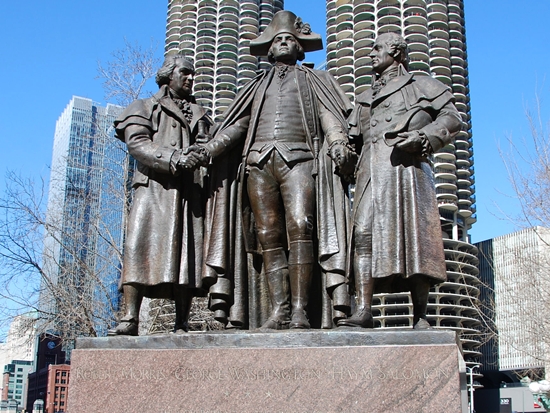
Jewish merchants and shippers supplied the Continental Army with sorely needed goods and services on credit. Who can forget the outstanding efforts of Haym Salomon, one of the most prominent financiers of the Continental Congress and Gen. George Washington’s war effort?
Salomon even personally secured the critical loan that funded the climactic campaign of the War of Independence, which led to the decisive victory at Yorktown. Salomon’s contribution was not only essential, but it also came at great personal cost. He reportedly died penniless because the newly born U.S. government was unable to repay its debts to him.
Many Jewish soldiers fought in the Continental Army. One particularly endearing tale involves an encounter between Washington and a Jewish soldier at Valley Forge in December 1777.
As Washington made his rounds of the encampment, he noticed a Jewish soldier weeping softly as the soldier was lighting Chanukah candles. Washington inquired about the tears, and the soldier responded that he was not crying but praying for victory. The soldier went on to tell the story of the holiday, and how a small army of patriots defeated a far larger and more powerful foe.
Washington then asked him, as a Jew and son of the prophets, whether the Americans would be victorious. The Jewish soldier replied that yes, the God of Israel, who helped the Maccabees, would help build a land of freedom.
It is reported that Washington told a Jewish family he visited on Chanukah in 1778 that the warmth of the glowing candlelight and the soldier’s words of optimism and courage on that dark night at Valley Forge uplifted him and gave him the fortitude to fight against all odds.
It is noteworthy that, when he became president, Washington sent a letter in 1789 to the Hebrew Congregations of Savannah, Ga. He referenced how the wonder-working Deity who had delivered the Hebrews from their Egyptian oppressors and planted them in a promised land provided providential agency in establishing the United States as an independent nation.
The contribution of Jewish thought to the founding of America includes principles of good governance that are rooted in the oral and written laws and traditions of the Torah. The Founding Fathers had access to this treasure trove of wisdom via translated sources of Hebraic literature and thought, extant at the time, when they formulated our constitutional republic.
Foremost among these sources were the writings of the 15th-century Jewish scholar Don Isaac Abarbanel. His deep and thorough analysis, cogent reasoning and compelling conclusions are bracing—every bit as fresh and thoughtful today. It is no wonder that his ideas were embraced by the U.S. Founding Fathers.
His thesis reflects his breadth of knowledge of the classics, including political philosophy; familiarity with a variety of other systems of government besides monarchy; and his life experience with the fickleness of kings and the capriciousness of affairs of state. Abarbanel argued that there is no biblical requirement for a monarchical form of government; to say that he disdained the concept of a king is an understatement.
Abarbanel’s position is supported by Deuteronomy Rabbah, which also takes a dim view of the people’s seeming need for a monarch. The midrash records that God said to the people of Israel that he wanted them to be free of monarchy and the dread of kings. What was the point of asking for a king if it meant being enslaved again, subject to the vagaries of monarchy and inevitable misdeeds of the king?
Moreover, as Psalms 146:3 cautions, we should not trust in the great, who are, after all, mere human beings, who cannot be counted on to save us. In that sense, reliance on a mortal king is not only misplaced but also akin to idol worship and doomed to fail. We can only truly trust in God.
Abarbanel counsels that, besides an elected government like the American constitutional republic, there should be term limits of one to three years for officeholders and a system of checks and balances.
He noted that one person with sole power is more likely to err than a group of leaders, since if one leader does wrong, the others will usually protest. Moreover, since their term in office is limited, there will ultimately be an accounting for any misdeeds they may commit.
This legacy is one of the reasons we are unabashedly American and Jewish. May the 250th anniversary of the birth of the United States be the beginning of even better times for all the good people of America.