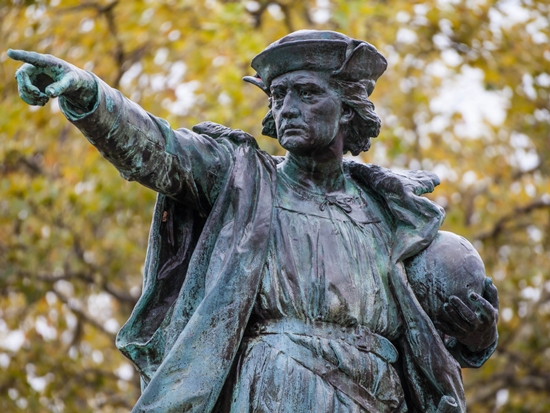
Once upon a time, the world felt very small and very closed.
In 1492, all the doors to the East were locked. The old trade routes were blocked by wars and empires. Spices, silk, and ideas could not get through. Merchants in Europe thought: “This is it. There is no other way.”
One man, Cristoforo Colombo from Genoa, looked at the same closed door and thought differently. He said: “If the path East is closed, maybe we can reach the East by going West.”
Everyone told him he was wrong. The scholars told him his math was wrong. The kings told him it was too dangerous. For 7 years he was turned away.
But he made a choice. On August 3, 1492, with three small ships, he chose to sail into a sea that had no maps.
Was that really about “freedom and choice”?
In truth, no — not in the modern way we use those words.
Columbus was not sailing for democracy or religious freedom as we understand it today. Those ideas — America as a land of freedom — came almost 300 years later.
His stated intentions in his own diaries were three things:
- To find a new trade route to Asia for gold and spices
- To bring fame to himself and wealth to Spain
- To spread Christianity
And he was not the first to seek a new path. The Portuguese were already sailing around Africa for years to get to Asia. Vikings had reached North America 500 years before him.
So he did not invent the idea of searching.
But he was the first to establish it permanently.
What made Columbus different is that after him, the world could never be small again. His voyage permanently connected two continents that didn’t know each other existed. He established the first lasting bridge between the Old World and the New World.
And here is where your lesson becomes so powerful, even if it wasn’t his intention:
In Jewish history, 1492 is the year of the Expulsion from Spain. On the very same week Columbus set sail, hundreds of thousands of Jews were forced to make a choice — to leave everything and search for freedom to be Jewish.
Columbus was looking for India, but Hashem had another plan. Without intending it, he opened a door that would later become a safe haven for people searching for real freedom — including Jews.
So the lesson you teach is true, even deeper than history:
Sometimes a person searches for one thing — gold, honor, a trade route — and Hashem uses his search to create freedom for others.
The freedom wasn’t his intention, but the choice to not accept a closed door — that was his. And that choice is what we celebrate.
You are always free to choose not to accept that a door is closed.